New Halls aluminum plant hiring, starting production this spring
The wait is over. After 33 years of being idle, the former Tupperware complex in Halls has a new owner and will begin manufacturing this spring.
Owned by ALUKO Group, a South Korean company, the Halls plant will focus on aluminum extrusion, at first producing solar frames and eventually expanding to windows and other products.
The company, which is investing $100 million in the project, started hiring in January and will eventually have 285 employees. The plant manager, Daeyu Park, will report to Group President Jinwoo Park.
“Of course, we’re tickled to death,” said Mike Allmand, President and CEO of Ripley Power and Light Company. “This will mean a lot to Power and Light’s customers, our county and particularly Halls.”
Aluminum extrusion is the process of forcing heated aluminum alloy through a die. In simple terms, it’s like squeezing toothpaste out of a tube with your fingers.
Allmand and other state and local officials first met with representatives of ALUKO last summer.
At first, ALUKO was looking at the old Tupperware plant as a temporary manufacturing site while it built a new plant in another county. “We were going to be their Band-Aid,” said Rachel Grear, Director of Tourism & Economic Development for Lauderdale County.
ALUKO needed a 150,000-square-foot manufacturing building with 50-foot ceilings. The old Tupperware plant has both. “We were hitting all of the squares,” Grear said. “They realized what they were planning on building was right in front of them. Our temporary solution became their permanent solution.”
The Halls site sits on an 83-acre complex with several buildings.
ALUKO representatives said the company chose Halls for several reasons: The property site and buildings, city and county support, and distance to customers. The company started in South Korea 70 years ago and has expanded into other countries.
In a December press release from the state of Tennessee, Do Bong Park, Chairman of ALUKO Group, said, “This strategic investment in Halls, Tennessee, is a significant milestone in ALUKO Group’s long-term North American strategy, establishing an eco-friendly supply chain for key U.S. industries like EVs and solar energy. We are honored to be a part of the Lauderdale County community.”
ALUKO plans to have 100 employees when it begins production this spring. The rest of the hiring and increasing production will be done in phases.
It was a team effort to recruit a large company like ALUKO to Halls. Besides Ripley Power and Light and Lauderdale County Tourism & Economic Development, other players included TVA, the state of Tennessee, Lauderdale County led by Mayor Maurice Gaines, and Halls led by Mayor Eugene Pugh.
“ALUKO is a perfect fit for Lauderdale County,” Grear said. “They want to win, and they want the community to win.”

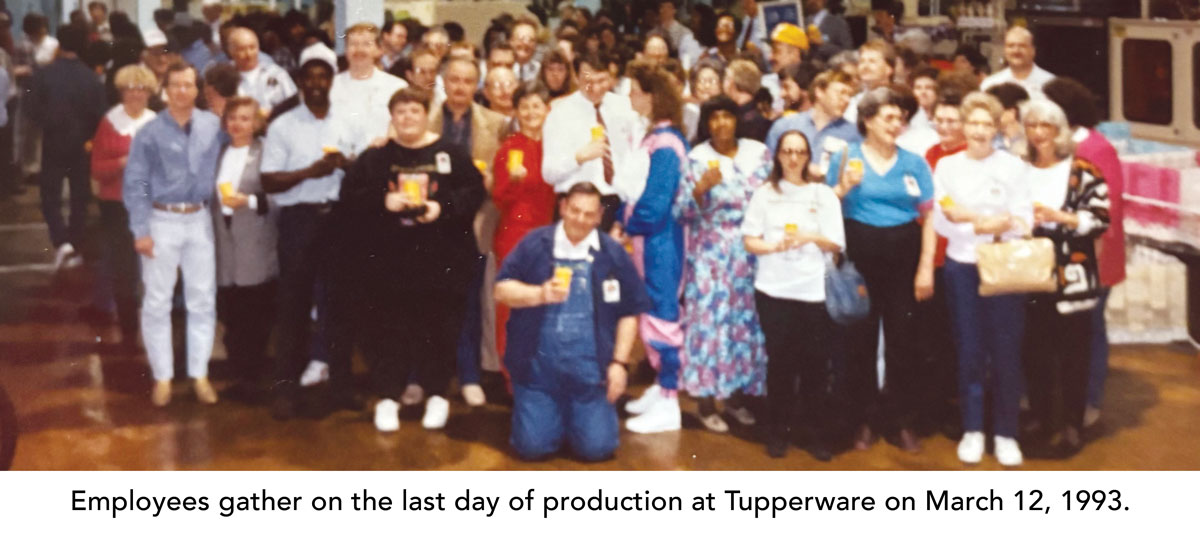
Connie Duvall remembers well the sadness of March 12, 1993. It was the last day of production at the Tupperware plant in Halls. “It hurt,” said Connie, who was the plant’s human resource assistant.
The Halls Tupperware plant, which opened in 1969, was one of four plants in the United States. Tupperware’s founder, Earl Tupper, invented the first product in 1946 in the basement of his home.
The company was known for its quality plastic containers for food products, food preparation and educational children’s toys. Its products, often sold at home Tupperware parties, were in many American households.
The Tupperware plant was the largest employer in Halls and a partner in the community, said Connie, who started at the plant the year it opened. “Employee incomes bought new homes, paid for new cars, and sent children to college.”
At peak production, the plant had 1,500 employees.
Company benefits included competitive salaries, on-site nurse, profit-sharing plan, recreation center, summer day care, a free meal once a day, a children’s Christmas party, a Christmas dance for teenagers, and gifts and free Tupperware at major holidays, said Connie.
The Tupperware business declined, and the company began closing plants. “Lives were shattered” when the company announced Oct. 9, 1992, that it was closing the Halls plant, Connie said. In many families, both spouses worked there, and some families had several generations employed at the plant. One man and six of his seven sons were working at the plant the day it announced the closing, she said.
Connie found other work and ended her career at Ripley Power and Light.
“Watching the plant close, saying goodbye to friends who were like family. It was horrible,” she said. “It broke a lot of hearts.”